
Terroir in Winemaking: What to Evaluate Before Planting a Vineyard
Updated: Oct 2
COA Insights, Chapter 1
Key question: is the land suited to the wine you want to produce?

Every wine project, whether a small family estate or a large institutional investment, starts with the same decision, even when no one formally treats it as one: choosing and evaluating the land.
Before any discussion of grape variety, wine style, or brand positioning, there is an earlier and more fundamental step. That step is technically called terroir analysis.
In this chapter, we draw on the scientific approaches of researcher Claudio Pastenes, professor at Universidad de Chile, a leading expert in plant stress physiology and viticulture, who defines terroir as the integrated interaction of five elements: climate, soil, water, plant, and human factor. This is the framework that structures the analysis below.
1. Climate (macroclimate and mesoclimate)
A region's climate, at both macro and mesoclimate scale, defines the vine's growing cycle, from budbreak to harvest, and with it the range of wine styles that are naturally viable. Warmer climates tend to produce grapes with higher sugar concentration and more evident body; cooler climates favor livelier acidity and more elegant, aromatic profiles. There is no absolute 'ideal climate': what matters is compatibility between the site's climate and the intended wine style.
Within climate, three variables deserve special attention. Altitude is directly linked to diurnal temperature range, the difference between day and night temperatures, which favors acidity preservation and aroma development during ripening. Sun exposure determines how much direct insolation each plot receives: insufficient exposure compromises ripening, while excessive exposure increases the risk of berry sunburn. And climate risks, such as late frosts, strong winds, excess humidity, and susceptibility to fungal disease, rarely show up on an optimistic first site visit, but sooner or later surface as yield losses or extra crop-protection costs.
2. Soil
Soil determines vine vigor, drainage capacity, and water retention, three variables that together shape the plant's balance. Very fertile, deep soils tend to stimulate excessive vegetative growth, which can dilute grape concentration and delay ripening. Poorer, well-drained soils, by contrast, tend to push the plant to invest energy in fruit rather than only in vegetative growth.

3. Water (water balance)
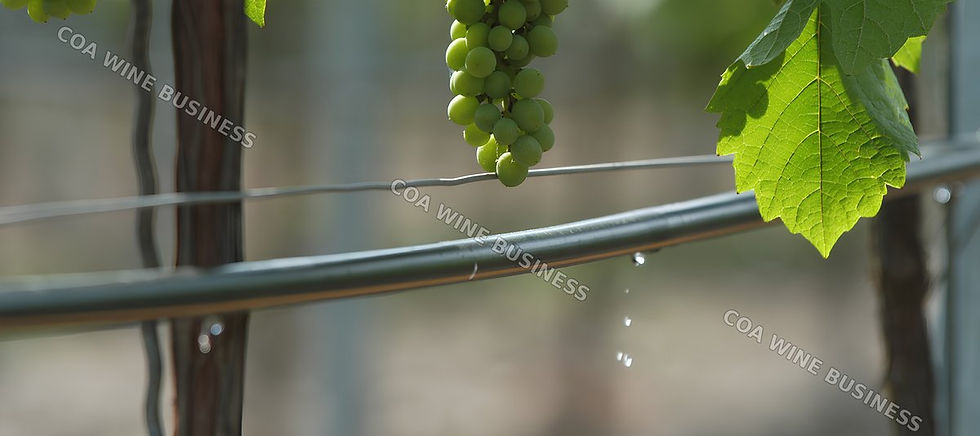
Water balance is fundamental to vine physiology. The natural availability of water, rainfall, water table, access to irrigation sources, regulates processes such as photosynthesis and determines whether the project will depend on supplemental irrigation. In precision viticulture, controlled water stress is even used as a tool to improve the concentration of quality compounds in the berry, such as tannins and aromatics. This is one of the most underestimated elements during land evaluation, precisely because its financial impact recurs every year, not just at planting.
4. Plant (plant material)
The fourth element is the plant itself: the chosen variety (or clone) and the rootstock it is grafted onto. It is the vine's genetics that interact directly with climate, soil, and water, translating those factors into the final composition of the fruit; the very same plot of land can express completely different potential depending on the variety planted. In upcoming chapters of this series, we go deeper into this choice: why variety is, in practice, the choice of a business model (Chapter 2), and how rootstock shapes decades of production (Chapter 3).
5. Human Factor
The fifth element, and the unifying one, is agronomic and enological management: the cultural decisions that interpret the land's potential and translate it into wine. Training system, pruning, irrigation strategy, harvest dates, and zoning are human choices that can express or waste everything the previous four elements offer. That is why two vineyards with physically identical terroir can produce completely different wines: people interpret the site and intervene to express, or not, its potential.
What this means in practice
Consider two hypothetical projects, established in the same region, with the same amount of capital invested. The first conducts a full technical terroir assessment before deciding on variety and training system. The second chooses the land based on criteria like the view, the price per hectare, or proximity to an already-established reference winery.
Years later, the first project harvests balanced grapes, within the planned style, with predictable management costs. The second lives with unbudgeted emergency irrigation, recurring disease pressure, or, in the worst case, a wine that never reaches the commercial positioning the original business plan projected.
This chapter's central message is direct: terroir doesn't guarantee quality. But it can limit the project's entire potential.

Why this is the first step of any project the COA advises on
A poorly done terroir assessment is not a mistake that can be fixed later with more investment in winemaking, branding, or sales channels. It is a structural limitation: the vineyard carries, for decades, the conditions of the land where it was planted.
That's why, before any discussion of variety, vineyard architecture, or commercial strategy, COA recommends that every project, new or expanding, start with the same question: is the land suited to the wine you want to produce?
This is the first chapter of the COA Insights series: the decisions that turn a vineyard into a sustainable business. In the next chapter, we cover the project's second major decision, choosing the variety, and why it is, in practice, the choice of a business model.
If you're evaluating land right now, or already have a vineyard in place and want a second technical opinion, book your Strategic Evaluation Session with COA: the amount invested is 100% deducted if you go on to hire any of our other services.
Subscribe to our newsletter and follow COA on Instagram and LinkedIn to keep up with the next chapters.
COA Wine Business Team
From Soil to Label: strategies to turn passion into business.


Comments