
Water in the Vineyard: Why Irrigation Is Not Just About Avoiding Drought
Why can two neighboring vineyards, in the same region and irrigated with the same total volume of water over the season, produce grapes with completely different levels of concentration and balance? The answer is not in the amount of water applied. It is in when, how much, and why.
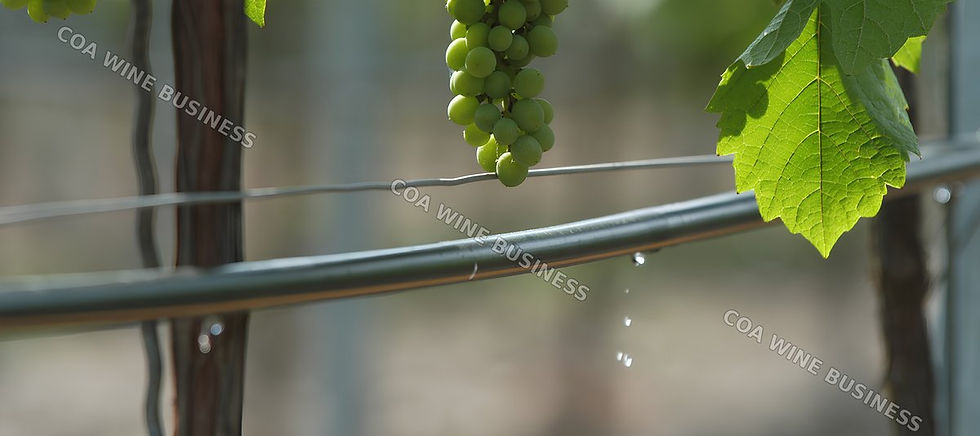
Drip irrigation system in operation in the vineyard.
This is the second chapter of Block II of our COA Insights series, Building Quality. Back in Chapter 1, based on the scientific approaches of researcher Claudio Pastenes, professor at Universidad de Chile, a leading expert in plant stress physiology and viticulture, we presented water as one of the five fundamental elements of terroir, alongside climate, soil, plant, and human factor. We covered it only briefly there, as part of the soil, water, and topography trio. After covering nutrition in Chapter 5, we now go deeper: how day-to-day water management, not just its natural availability, determines the vine's physiological behavior.
Irrigating is not about replenishing water until the soil feels moist. It is a technical decision that can be used to control the plant's behavior, or that, poorly managed, dilutes everything the previous decisions in this series have built.
1. Diagnosing the plant's water status, not just the soil's
Measuring soil moisture shows how much water is available, but not how much water the plant is actually using, nor the level of stress it is experiencing. Tools such as tensiometers, capacitance probes, and the pressure chamber, which measures leaf water potential directly on the plant, answer that question with precision. Irrigating on a fixed schedule, or by the feel of the soil in your hand, ignores the real variation between blocks with the same soil and the same exposure.
2. Controlled water deficit as a quality tool
Applied in the right window, between fruit set and the onset of ripening, a controlled water deficit reduces berry size and concentrates color, tannin, and aromatic compounds. This is the central nuance of precision viticulture: water stress stops being just a risk to avoid and becomes a quality tool, as long as it is monitored with the data from the previous criterion. Outside that window, or without control, the same stress compromises photosynthesis and delays ripening instead of refining it.
3. Irrigation system design and zoning
Building on Chapter 4 of this series, water infrastructure needs to be planned as early as vineyard implementation, even in dry-farmed projects. And as Chapter 1 itself showed, soil and topography vary within a single block, so a zoned drip system, allowing each zone to be watered according to its own water retention and its own slope, avoids treating a vineyard as uniform when it is not.
4. Phenological timing of application
Just as with nutrition, each phase of the cycle has a different response to water. Post-harvest replenishment builds the soil's water reserve for winter and the following budbreak. Controlled restriction between fruit set and véraison is the quality water-deficit window described in criterion 2. And close to harvest, fine-tuning prevents a late irrigation, or even poorly managed rainfall, from diluting in a single event the concentration built over the entire season.
What this means in practice
Imagine two vineyards with the same variety, the same rootstock, the same spacing, and the same irrigation system installed at implementation, decisions already discussed in earlier chapters of this series. In the first, irrigation is guided by diagnosis of the plant's water status, with controlled deficit in the right window and fine-tuning by zone. In the second, irrigation follows a fixed volume, without differentiating phenological phase or soil variation within the block.
At harvest, the first vineyard arrives with concentrated berries, developed color and tannin, and a predictable harvest window. The second deals with diluted berries in part of the block, excess vigor where the soil retains more water, and uneven ripening between zones that should behave the same way. The difference is not in the variety, the rootstock, or the implementation. It is in water management.
Water is not an input to be replenished until it runs out. It is a variable to be controlled, in the right amount and at the right time, turning a natural limitation into a quality tool, or becoming the source of dilution and imbalance across the entire harvest.

Why COA treats water as a strategic decision, not routine
At COA Wine Business, water management is treated as part of the vineyard's strategic management, integrated with the soil, rootstock, implementation, and nutrition decisions already made, because that integration determines whether the potential built in earlier stages converts, or not, into real concentration and balance in the grape.
With this chapter, we continue deepening Block II of our series. In Chapter 7, we cover vineyard architecture: how canopy management controls light, temperature, health, and ripening.
Subscribe to our newsletter and follow every chapter of this series at coawinebusiness.com.
Follow COA Wine Business on Instagram and LinkedIn to keep up with the next chapters of this series.
Want to assess your own vineyard's water management with technical support? Book here your Strategic Assessment Session with the COA team.
COA Wine Business Team
COA Wine Business. From soil to label.


Comments