
Vineyard Implementation: The Project Begins Before the First Post
Why can two vineyards planted in the same region, with the same variety and the same soil, end up with completely different production costs for decades? The answer is almost never in the winery. It's in the implementation.

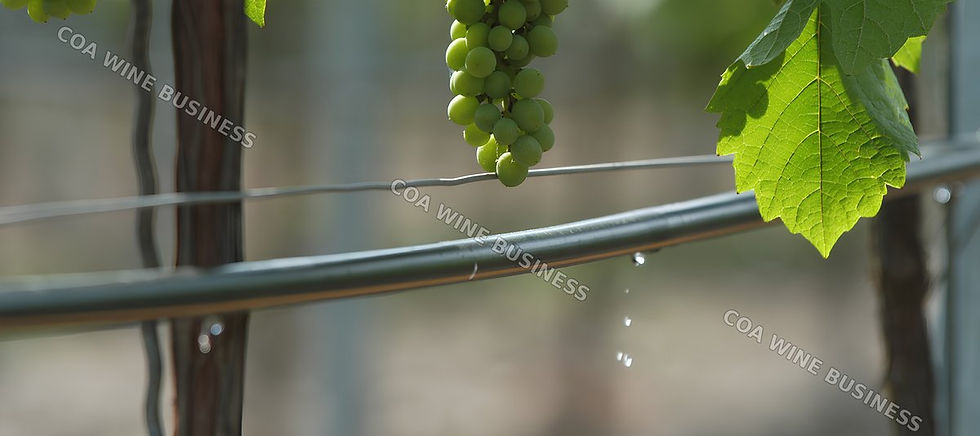
Vineyard in the implementation phase in Gualtallary, Tupungato, Uco Valley, Argentina. Vineyard agronomist in charge: Gonzalo Mazzotta.
This is the fourth and final chapter of Block I in our COA Insights series, dedicated to the origin of wine quality. In Chapter 1, we showed how soil, water, and terrain define a site's potential. In Chapter 2, we discussed how variety choice turns that potential into a business model. In Chapter 3, we covered rootstock as the engineering decision that adjusts vigor and balance to the terroir. Now, we close the cycle: how all these technical decisions become, or fail to become, a vineyard that works day to day.
Implementation is the moment the project leaves the paper and becomes permanent infrastructure. Mistakes made here can't be fixed with pruning or fertilization. They stay etched into the vineyard for 20, 30 years.
1. Row orientation
The direction of the plant rows determines how much sunlight each plant receives throughout the day and how wind moves through the canopy. Building on the terrain analysis from Chapter 1, the ideal orientation depends on the topography, the predominant sun exposure, and the prevailing winds of each property. There's no universal rule: an orientation that works perfectly on flat land can be unworkable on a slope, where orientation also has to account for water runoff and erosion risk.
2. Spacing
The distance between plants and between rows defines planting density, and planting density is a decision that connects directly to two variables already covered in this series: rootstock vigor, the topic of Chapter 3, and soil fertility, the topic of Chapter 1. A vigorous rootstock in fertile soil, planted with tight spacing, tends to create excessive competition between plants and vegetative imbalance. The right spacing is always an equation between expected vigor, actual soil fertility, and the project's winemaking goals.
3. Mechanization
Few implementation decisions have as direct and lasting a financial impact as designing the vineyard for mechanization. As we discussed in Chapter 2 when covering the business model, labor cost and the availability of skilled workers are structural variables for a vineyard's economic viability. Row spacing that doesn't allow equipment to pass through, or that requires costly adaptations to machinery, turns a planting decision into a permanent operational cost.
4. Future irrigation
Even in projects that start as dry-farmed, irrigation infrastructure should be planned for during implementation. Building on the water element from Chapter 1, a site's water availability can change, whether due to climate variability or future management decisions. Installing basic irrigation infrastructure during implementation, even if it isn't used right away, costs a fraction of what it costs to retrofit a mature vineyard. This is also a topic we'll revisit in more depth in future chapters of this series, when we cover water management.
What this means in practice
Imagine two vineyard projects in the same region, with the same rootstock and the same variety, as defined in the previous chapters of this series. In the first project, implementation was planned together with a row orientation study, spacing calculated from expected vigor, and a design compatible with the mechanization available in the region. In the second, implementation followed the local standard, without considering these site-specific variables.
Five years later, the first vineyard operates with predictable management costs and a uniform response to interventions. The second lives with vegetative imbalance in parts of the block, difficulty mechanizing certain operations, and a structurally higher labor cost. The difference isn't in the variety, the rootstock, or the soil. It's entirely in the implementation.
Implementation is the decision that turns a well-planned vineyard into an operationally viable one, or into a project that carries inefficiencies for decades.

Why COA treats implementation as a strategic decision, not just an operational one
At COA Wine Business, implementation is treated as part of the vineyard's strategic project, not as an execution step separate from the earlier technical decisions. Row orientation, spacing, mechanization, and future irrigation are analyzed together with the soil, water, terrain, variety, and rootstock already defined, because it's this integration that determines whether a vineyard will be operationally viable over decades.
With this chapter, we close Block I of our series, dedicated to the origin of wine quality: soil, water, terrain, variety, rootstock, and implementation. In Chapter 5, we begin Block II, Building Quality, starting with a topic that's often misunderstood: nutrition. As we'll see, nourishing isn't the same as fertilizing. It's about controlling balance.
Subscribe to our newsletter and follow every chapter of this series.
Follow COA Wine Business on Instagram and LinkedIn to keep up with the next chapters of this series.
Want to evaluate your own vineyard's implementation with technical support? Book here your Strategic Assessment Session with the COA team.
COA Wine Business Team
COA Wine Business. From soil to label.


Comments